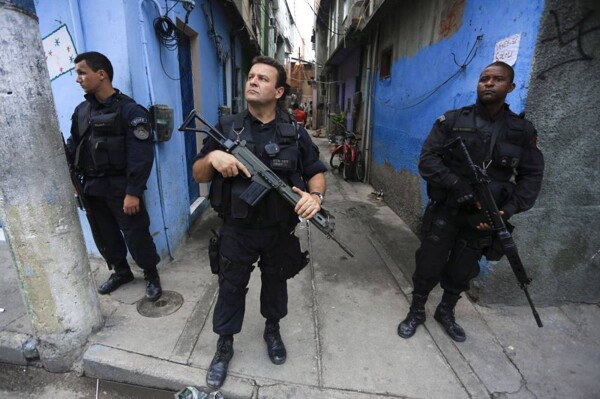
Rio de Janeiro, October 29, 2025 — Rio de Janeiro experienced one of its bloodiest days in recent history. A mega-police operation involving 2,500 agents, helicopters, armored vehicles, and drones left at least 64 dead, including four police officers, and over 80 detained. The operation was aimed at the Comando Vermelho, the country's most powerful criminal organization.
The operation began before dawn in the favelas of the Alemão and Penha complexes in northern Rio. The objective was to capture Edgar Alves de Andrade, alias “Doca” or “Urso,” considered the regional leader of the Comando Vermelho. In parallel, the Civil Police confirmed the death of four of its officers during clashes.
The Comando Vermelho, founded in the 1970s in Rio's prisons, is today Brazil's oldest and most powerful criminal organization, with connections in Bolivia, Paraguay, and Colombia. According to the World of Crime observatory, the most lethal operations in the history of Rio de Janeiro have occurred during the current governor Castro's administration, reopening the debate on the limits of the use of force in densely populated areas.
However, the scale of the operation and the number of victims have drawn criticism from human rights organizations and political sectors demanding explanations on the use of force. The Secretary of the Military Police, Marcelo de Menezes Nogueira, reported that the origin and handling of the bodies transported by neighbors will be investigated.
This is the highest recorded number of deaths in a single day during a security operation in Brazil. The operation, considered unprecedented for its scale and coordination, involved more than 2,500 personnel from the Military Police, Civil Police, and the Army, supported by helicopters, armored vehicles, and drones.
Human Rights Watch reminded that Rio de Janeiro has a long history of extrajudicial executions in police operations and warned that this offensive “could aggravate the cycle of structural violence the city suffers.”
Governor of Rio de Janeiro, Claudio Castro, stated that the criminals were “neutralized” and described the action as “the largest in the city's history.” Along with Vice President Geraldo Alckmin and Minister of Justice Ricardo Lewandowski, they analyzed measures to contain the violence. The government offered to transfer detainees to federal maximum-security prisons and, for the moment, ruled out declaring the Guarantee of Law and Order, which would imply direct intervention by the Armed Forces.
The scale of the operation and the magnitude of human losses have placed Rio de Janeiro at the center of a national debate on the fight against drug trafficking, the limits of the use of force, and the structural crisis affecting Brazilian favelas.
The operation included more than 30 armored vehicles, two support helicopters, and about a dozen demolition vehicles to open a path through narrow alleys blocked by burning barricades.
“Doca,” born in the state of Paraíba in 1970, is accused by the Prosecutor's Office of multiple homicides, drug trafficking, torture, and criminal association. In recent years, Castro has promoted a “hard line” policy that, according to human rights organizations, has multiplied lethal clashes in the favelas.
The offensive unleashed a wave of violence that paralyzed large sectors of the northern city. His criminal structure controlled drug sales points in Penha, Vila Cruzeiro, and Morro do São Simão, as well as coordinating attacks on police stations.
The human cost and the criticism
During the raid, authorities seized 93 rifles, a large quantity of ammunition, and more than half a ton of drugs. Residents of Penha and Alemão recounted hours of panic under crossfire, with bursts of rifle fire, drones dropping grenades, and helicopters flying at low altitudes.
The group controls basic services and exercises territorial power in neighborhoods where the State has historically been absent. Security experts warn that the group, more than a traditional criminal organization, acts as a paramilitary apparatus capable of challenging the State.
“It looked like a war,” described a resident at the end of the day. Various human rights organizations denounced the excessive use of force.
According to the latest official report, the mega-operation against the Comando Vermelho (CV) drug cartel left at least 120 dead and over 80 detained. The objective was to dismantle CV's operational bases in the favelas of the Penha and Alemão complexes, where the most violent clashes were concentrated.
During the early morning of Wednesday, residents of the Penha favela moved dozens of bodies to the São Lucas square on José Rucas Avenue to identify the victims. Police forces blocked access, stormed in with armored vehicles, and advanced house by house, while helicopters and drones patrolled the area, detecting suspicious movements.
Authorities reported the seizure of 42 high-caliber rifles and the arrest of 81 people. Its structure combines imprisoned bosses, lieutenants in the favelas, and money laundering networks that extend to several Brazilian states.
Local media reported that at least 56 bodies were lined up in the street, some still covered in plastic and blood-stained cloths. The images reflected scenes of pain and desperation: relatives lifted the covers in search of their loved ones, while others cut pieces of clothing to recognize them.
More than 200,000 people were affected by the suspension of public transport and services.