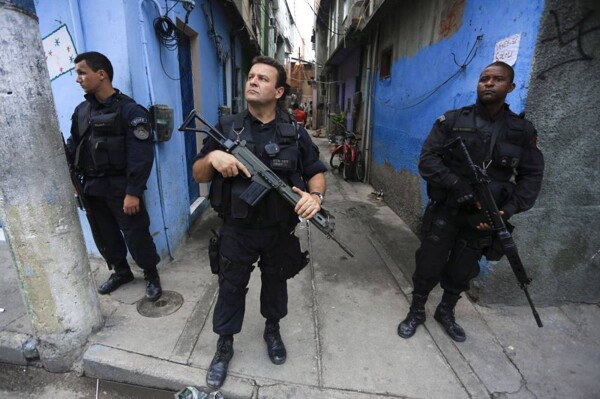
The authorities use death and bloodshed as a means to boost their ailing political careers. Instead of intelligently pursuing crime where it is organized and money is made — in wealthy neighborhoods, tax havens, and seats occupied by white-collar criminals and militia officers — the state chooses to exterminate indiscriminately in the favelas people who already suffer from poverty, unemployment, and the absence of state policies, beyond another failed massacre project that has governed the state for over 20 years. A police operation that only kills the poor and Black has another name. What is happening in Rio, besides an announced tragedy, is a decision. Justice, truth, and reparation. We demand the impeachment and imprisonment of the governor of the State of Rio de Janeiro, Claudio Castro. We demand that the Brazilian State take responsibility for the families shattered by this genocidal operation. That the victims have the right to a dignified burial. That a Parliamentary Commission of Inquiry be opened into the people involved in this operation. And that the issue of drugs be addressed within Public Health Policy, not Public Security Policy. These massacres perpetuate violence, cover up institutional responsibility, and destroy families. The major leaders of organized crime live in luxury condos in Brasília, hold political office, enjoy parliamentary immunity, and even use public services to protect their partners in the favelas. Because, do we really believe the fallacy that the major leaders of organized crime live in the favelas? And mainly, who really profits not only from the sale of drugs, but also from the narrative of security and the other crimes surrounding drug trafficking? Because, even if several of the victims were involved in crimes, the selective and exemplary slaughter is the crudest face of a supremacist political system. Because they are poor, Black, marginalized, who committed the crime of being in the wrong place at the wrong time. It is very sad to see the dehumanization of so many people murdered, thrown away like trash, and their families recognizing their loved ones under the police's weapons. Again, in the name of public security, Black and poor bodies die. The difference is that no one enters their neighborhoods shooting, beheading, or torturing as they do in the favelas. The governor of Rio de Janeiro, Cláudio Castro, right-hand man of Bolsonaro, has chosen to turn public squares into corpse deposits. The last sigh of Bolsonaro's coup plotter dream. We demand an independent investigation, that the bodies be examined to determine how they died, that it be made clear they were executions, that those who ordered and carried them out be held accountable, and, of course, public policies to prevent these massacres. Do you want a debate on how American imperialism has actively contributed to organized crime when it has suited them? Today, that plan materializes in throwing Brazil into the fire, as a plan of betrayal. That is a barbarity and we cannot normalize that massacres like this continue to happen. Do you really want a debate about drug trafficking? The obsession with maintaining a place of privilege in the reactionary international policy led by the United States has reached the point of normalizing — and even defending — a Caribbean and all of Abya Yala penetrated by American and French militarization (in the latter case, over its still-colonized territories in the Antilles). It is institutional racism, unjustified militarization, and impunity under the false premise of security. Yesterday, a large police operation in the Complexo do Alemão and in the Morro da Penha has claimed the lives of 150 people for now, although the figure is not final as bodies are still being recovered from the mountain — which are found with their hands tied behind their backs with zip ties, many in their underwear and with rifle shots to the head, which, in addition to making identification difficult, forces families to hold the wake with the coffin closed, adding insult to injury. Today in Rio, mothers and grandmothers do not let their children go out to play in the street, they do not send them to school for fear they will have the same fate as their older brothers, cousins, aunts, friends, and fathers. We have to react and demand accountability from those who have turned this brutal violence into the not-so-new state policy. No police officer, no institution, no government, no State/nation should have the legitimacy or the power to decide who lives and who dies. From the logic of those who worry about the state's racist violence, if our dead are criminals, cleaners, drivers, unemployed, or students, it is all the same to us. To see people celebrating, the country's worst massacre, which has the sad honor of surpassing Carandiru and its 111 dead, today turned into statistics and movies. Today, we see that in Abya Yala there is a plan to take advantage of the wave of drug dealer hunts as a pretext for imperialist intervention in Latin America. As we say there: When a mother loses a child, all mothers lose one too. This “police operation” shows how the state and police treat the favelas and Black and poor people as disposable, as disposable beings. Because those who defend the rule of law and due process have historically had a double standard for the exploited classes of racial capitalism from which they benefit. For those who stay at home, it is a synonym for dismissal or several less days of the monthly salary, which barely covers the bills. But it's not just Rio de Janeiro crying, all of Brazil is crying, Brazilian mothers are crying. The numbers don't add up. On television, radio, and social media, the news is confusing. Fear that helicopters will shoot from the air, in the schoolyard, fear of being confused with the powerful drug traffickers, who are never found. Today there is a curfew, there is an alert level two, it is recommended to avoid travel, but who takes care of the children, the nephews, the elderly, the women who work in the rich people's houses? Organized crime cannot exist without corruption in the police, politicians, and the financial system. Those who die in “police operations” are not organized criminals, they are dispensable. This Sunday, November 2nd, several migrant collectives of the Brazilian community gathered at Sant Jaume Square in Barcelona to denounce and reject the massacre that took place last October 28th, where the Rio de Janeiro Police, led by the bolsonarist Claudio Castro, carried out an operation against Comando Vermelho, where more than 150 people were murdered. Today in Rio there is no music, no laughter, no joy. Only the number of victims is spoken of as if they were not human beings, they didn't even deserve a little attention and respect from their families. A eugenics policy disguised as public security, which makes fear a methodology and death a discourse. “Police operations” are political propaganda, a spectacle, a farce. A whole career built on the corpses of non-white bodies. Who funds and carries the weapons to these places? Hundreds of lives to recover 73 weapons and an airplane that is more for scrap than anything else. The city awoke in silence, trembling, sad.