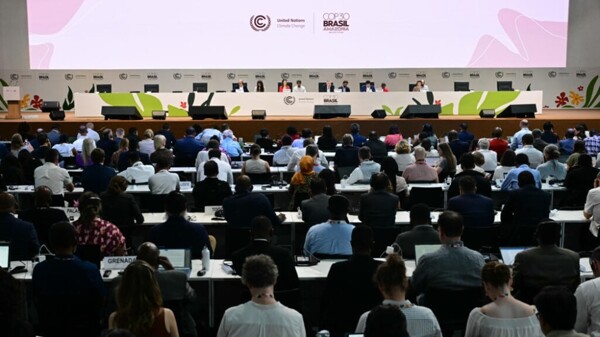
Governments of the world, at the United Nations Climate Change Conference (COP30) in Brazil the day before yesterday, agreed on a climate deal aimed at enhancing financing for poor countries facing global warming, without any mention of the fossil fuel causing it.
Through this global consensus, Brazil sought to emphasize the importance of addressing the impacts of climate change, even after the United States, the world's largest historical source of emissions, refused to send an official delegation.
However, the agreement, reached after extending the negotiations in the Brazilian city of Belém, also revealed disagreements between rich and developing nations, as well as between governments holding opposing views on oil, gas, and coal.
After reaching the agreement, the president of the conference, André Corrêa do Lago, acknowledged the difficulty of the talks, saying, "We know that some of you had greater ambitions on some of the issues raised."
Several countries objected to the summit ending without stronger plans to curb greenhouse gas emissions or address the issue of fossil fuels.
The "Belém" agreement launches a voluntary initiative to accelerate climate action to help countries meet their current commitments to reduce emissions. It calls on developed countries to increase the amount of money they provide to help developing nations adapt to the impacts of global warming by at least threefold by 2035.
Scientists have confirmed that current national commitments to reduce emissions have significantly lowered expected warming, but they are not enough to prevent the Earth's temperature from exceeding 1.5 degrees Celsius, a level that portends worse effects of climate change.
Meanwhile, developing countries have reaffirmed their urgent need for funds to adapt to impacts that have already begun, including rising sea levels, intensifying heatwaves, droughts, floods, and storms.
The issue of adaptation has garnered renewed attention from prominent figures in climate-related philanthropy, such as Bill Gates, who recently called on governments to "shift" towards financing this type of intervention. Record amounts from philanthropic institutions flowed into the "adaptation" space last year, and this financing more than doubled, reaching $870 million between 2021 and 2024.
Yet, nearly a decade after adaptation goals were first set as part of the Paris Agreement at COP21, it has proven difficult to rally support.
Diplomats at COP30 sought to agree on a specific list of 100 indicators that could be used to measure progress and guide funding, but these efforts quickly stalled. Developing countries most vulnerable to climate change's effects are concerned that setting goals without securing adequate funding could render the process meaningless.
By 2035, developing countries will need between $310 billion and $365 billion annually for adaptation projects, according to estimates from the United Nations Environment Programme. This figure far exceeds the $40 billion per year agreed upon at the COP26 summit in 2021.
One problem is that cutting emissions is cheaper than protecting at-risk populations. Gareth Phillips, who works in climate finance at the African Development Bank and attended the Brazil summit, said, "Low-carbon technologies are already cheaper, easier to build, and increasingly widely available. As we gradually mitigate, we now need to start focusing on adaptation."
However, others are concerned that the shift in focus could provide cover for those who want to continue polluting.
Wafa Miseer, who attended COP30 with the African Climate Justice Network, a network of NGOs, said, "Adaptation without mitigation is like saving a sinking boat without patching the hole." She added, "Communities living the crisis every day, from coastal farmers to coastal fishers, know exactly why mitigation is important: every tenth of a degree we avoid is a life, a crop, or a home saved."
According to "Climate Action Tracker," a partnership of climate researchers analyzing the policies countries submit to the UN as part of the COP process, there has been no significant improvement in climate action plans over the past four years. This puts us on a path to an unpredictable future with more intense droughts and floods and higher temperatures.
However, the impacts will not be equal. The worst effects of rising temperatures are being felt in places that have historically contributed far less to the emissions causing climate change. This has all led to calls for more funding from richer countries to help developing nations adapt.
According to estimates from the United Nations Environment Programme, developing countries will need between $310 billion and $365 billion annually for adaptation projects by 2035.