During his first term, the current Brazilian President, Luiz Inácio Lula da Silva, launched a pioneering program called 'Light for All' aimed at providing electricity in rural areas. Over the years, this program successfully brought electricity to millions of people, becoming one of Brazil's most prominent social projects.
The program focuses particularly on the Amazon region, where solar battery systems are used to provide power. An example of this is the 'Lady Maya' system.
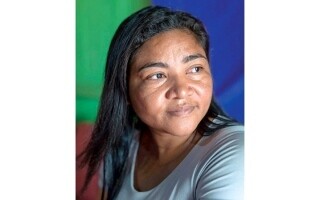
Despite the slow arrival of electricity in some remote areas, the beneficiary families were extremely happy. Among them is the large Maya family, living on Pacajá Island. Maya, a mother of nine children, expressed her great joy at having electricity in her home, noting that she had lost the ability to count her grandchildren and great-grandchildren due to their large number. On the day electricity was connected to their home, many family members gathered, preparing to travel by boat together to a football championship held between Pacajá and Gotuba islands. From a distance, despite the humid and foggy air, the glittering horizon of the city of Belém could be seen, a city with an estimated population of two million people. As the Maya family returned home after the championship, the solar batteries were already working. Maya felt comfortable, sitting on her swing and watching her favorite TV show 'Fantástico'. At the same time, the noisy sounds of her children's mobile phones rang out. One of her sons, 42-year-old Raimundo Maya Moraes, who spent his early morning hours climbing palm trees to pick fruits, opened one of his applications, expressing his great joy at the realization of this event after electricity came to the family's home.
'Energy Poverty' Since 2000, the world has seen a significant improvement in electricity access. The percentage of the world's population with access to electricity rose from about 75% to around 90% by 2020, according to the World Bank.
Despite this significant progress in expanding electricity grids, the mere presence of a grid does not necessarily mean that residents benefit from it. Many regions face problems such as frequent power outages, or electricity costs that are so high that their use is limited, or insufficient supply to meet daily needs.
Therefore, the expansion of electricity services did not automatically translate into a tangible improvement in the lives of all people. A recent study showed that about 1.18 billion people suffer from what is known as 'energy poverty,' meaning they cannot effectively use electricity in their daily lives. This figure represents a significant increase of about 60% compared to 2020, when approximately 733 million people had no access to electricity at all, according to available official data.
But the real challenge lies not only in connecting people to electricity but in ensuring it is continuously available, affordable, and of sufficient quality to allow them to benefit from it in their daily lives and essential activities such as cooking, education, and small-scale industry. High electricity costs limit its use.
Although the contribution of poor communities to emissions is extremely small, their suffering from energy deprivation remains significant. For many, obtaining electricity represents the first step towards integrating into a broader, more stable economy.
17 million people without electricity in the Western world, while another 60 million rely on small diesel generators.
Doubling Efforts Isabel Beltrán, head of Latin America and the Caribbean for the Global Alliance for the Planet and People, said that most electricity gains are achieved by expanding public grids, but reaching remote and isolated communities requires doubled efforts and greater investment to ensure that light is not the privilege of certain communities but a right for all.
'Light for All' brings joy to rural residents 'Light for All' has become one of Brazil's most prominent social projects.
In a bay near Akita Island in Brazil, the masts of anchored ships rose on one side, appearing as floating, glittering cities at sea. These ships were converted into temporary hotels for thousands of participants in the climate summit, held last month in the vicinity. In a captivating scene, the lights of the ships glittered as officials inside discussed ways to secure and increase cleaner, more sustainable energy sources for the world.
However, this bright scene hides a completely different reality nearby. In the same bay, people live who only received electricity this year, while others are still waiting their turn.
This reality is not unique to Akita Island in Brazil; it represents the situation of hundreds of millions of people around the world who are still deprived of electrical energy, despite it being one of the greatest achievements of modern civilization and the most essential for daily life.
Deprivation Joulma Morais Anju, born and having lived her entire life on Akita Island, said that it had been only about nine months since electricity became regular in her home. She added, using language inspired by climate discussions: 'It's as if we are part of a climate conservation conference.' These international discussions had indeed taken place a few miles away in the vast city of Belém, located on the outskirts of the Amazon rainforest.
Although the largest percentage of people living without electricity is concentrated in Africa, a significant number in the Western world are still deprived of this essential service. About 17 million people live without electricity at all, while about 60 million others rely on small diesel generators, one of the most polluting and most expensive energy sources.
In the Brazilian Amazon region alone, about one million people have no access to electricity, while another two million people rely on diesel to generate it.
Most of these residents belong to indigenous communities or people of African descent, spread across South America and the Caribbean. In other cases, as on Pacajá and Gotuba islands, the population is of mixed descent and lives on the banks of the Amazon River and its numerous tributaries.
Great Hardship Although the contribution of these groups to greenhouse gas emissions is extremely small, their suffering from energy deprivation remains significant.
A typical American refrigerator running year-round produces emissions that exceed those of most of these people combined.
Nevertheless, the issue of bringing electricity to the world's poor remains an urgent matter that cannot be delayed.
With the growing population, dependence on firewood for cooking has become one of the main factors in deforestation, especially in poor areas.
Many governments of developing countries have defended their right to use fossil fuels, arguing that the rapid expansion of electricity access should not be blamed, even amid increasing climate concerns.
For many, obtaining electricity represents the first step towards integrating into a broader, more stable economy. At the family level, it could mean owning a refrigerator, a television, or a smartphone with a camera and communication apps that can be constantly charged.
At the community level, it could manifest as having public address systems, public Wi-Fi networks, or electric machines such as oil presses that increase production efficiency and help local residents increase their income.
The Impact of Electricity In conclusion, almost no aspect of daily life is free from the impact of having or lacking electricity. This was clearly illustrated in a recent simple event on a sandy shore opposite the climate summit ships, where residents of Gotuba and Pacajá islands gathered to hold a five-a-side football championship. The winning team was supposed to receive a bull as a prize, but this bull was unremarkable: it was skinny and its horns were crooked.
As darkness fell, the final match could not be played, and the referee was forced to end the championship due to sunset and the lack of necessary lighting. The two teams that reached the final agreed to slaughter the bull and share its meat instead of continuing the match.
A Different Reality Despite the romanticized image of traditional lifestyles often painted in climate change discussions, Isabel Beltrán, head of Latin America and the Caribbean for the Global Alliance for the Planet and People, asserts that the reality is different. She says: 'If people are given the opportunity to have electricity, very few will choose to live without it. It's not just about making life easier, but also about opportunities for livelihoods.'
The experience of 80-year-old Antonia Maya clearly illustrates this reality. She spent most of her life without electricity until this year, when she received a solar battery system under a government program. She says: 'We were forced to either use salt or buy ice every day to keep the fish from spoiling.' Antonia's family depends on fishing and picking fruits from the palm trees surrounding her home for their livelihood, but she considers this work strenuous and costly, and it no longer covers the family's expenses as it used to.
Antonia lives with her family on the coast of Pacajá Island in a residential complex built on wooden stilts connected by narrow walkways. This year, they received three battery systems out of about 300 installed by 'Equatorial Energia', the largest utility company in northern Brazil, in cooperation with the government as part of the 'Light for All' program, which aims to bring electricity to rural areas. Residents pay about five dollars per month for each battery.