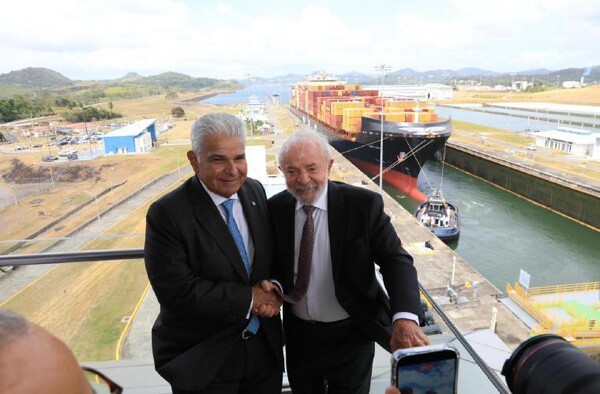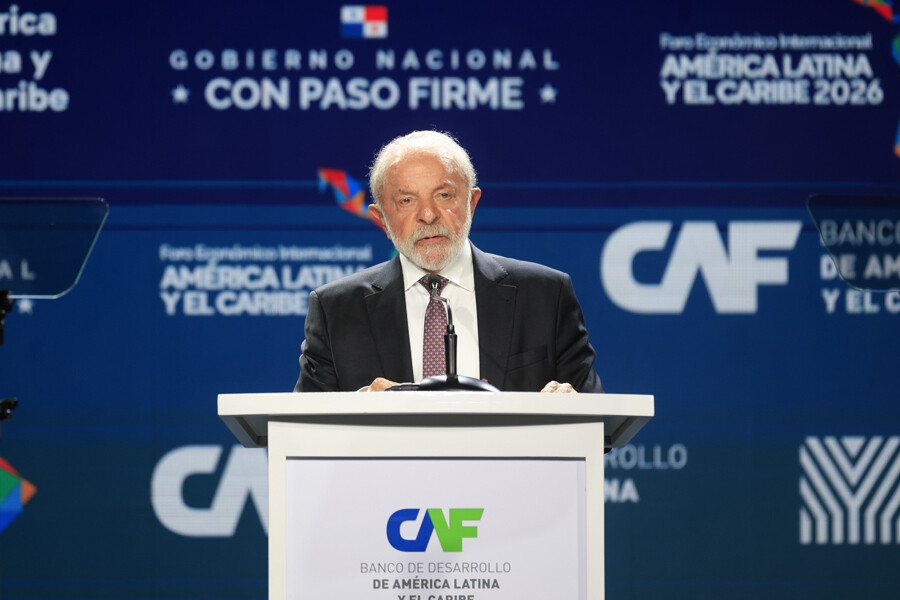
The president of Brazil, Luiz Inácio Lula da Silva, stated this Wednesday in Panama City that Latin America is experiencing one of the "biggest setbacks" in its integration history, and advocated for a "possible regionalism" guided by pragmatism.
Lula, who is participating in the International Economic Forum for Latin America and the Caribbean, criticized in his speech the lack of a united response from the region to the U.S. military intervention in Venezuela, in which President Nicolás Maduro was captured.
"The Community of Latin American and Caribbean States (Celac) cannot even produce a single statement on illegal military interventions that affect our region," he stated.
In this sense, he said that Celac is "paralyzed" despite the "efforts" of its pro tempore president, the Colombian Gustavo Petro, while the Union of South American Nations (Unasur) "succumbed to the weight of intolerance that prevented the coexistence of different visions."
"We have become a divided region again, more oriented outwards than inwards," he declared, before adding that countries allowed "ideological disputes" to prevail.
In this context, Lula affirmed that integration doctrines such as bolivarianism are "insufficient," while the European Union model is "unviable" due to the "weight" of national institutions.
Therefore, the head of state stated that the "possible" integration model is one that helps to "overcome" ideological differences and seeks to combat poverty and inequality.
According to Lula, the region has assets that can boost integration, among which he highlighted hydrocarbon reserves, biodiversity, and abundant mineral resources.
He cited the agreement signed between the European Union and Mercosur as an example of recent progress and said that this bloc will seek to expand its partnership with countries such as Mexico and India.
"Reconquering trust in integration is an arduous but necessary task," he declared.